Where The Wild Things Are
This film, directed by Spike Jonze is easily one of the best of 2009 so far. Mark Harris
 , in a recent editorial in Entertainment Weekly, argues that WTWTA is worth seeing, if for no other reason, because it is a film that divides the audience. It is one of the few recent big budget, Hollywood films that is worthy of having an argument over. Some will say it shouldn't be a kids film, and others (like me) will say it's exactly what a kids film should be. Max, the central character, is a kid who's very angry, as many kids are, and that's an issue most stories intended for a juvenile audience won't explore. Max is angry at his sister for not standing up for him. He's angry at his mother and the strange man she has over for dinner, and he runs away to create a fantasy land in his imagination, to help him cope with his anger. WTWTA deserves credit, if for no other reason, for having the guts to see the world honestly from a child's point of view, and dealing with real emotions. Lucky for us, that's not the only good thing about the movie. It's incredibly well shot and edited, and all the talent involved is at the top of their game, even if we only hear their voices, and since the Best Picture category in the Academy Awards has been increased to a field of 10 this year there's a good chance this will snag a nomination. 10/10.
Whip It
Drew Barry
 more pulled a rabbit out of a hat in her directorial debut. Whip It is the surprise great film of the year. It stars Juno's Ellen Page as a misfit youth who discovers a passion for the all girl sport of Roller Derby. She practices, tries out, makes the team, and soon becomes a surprise star in the league because of her speed on the track. Her mother, played by Marcia Gay Harden, disapproves, instead wishing she would participate in beauty pageants like she did. Her father, played by the great (and underworked) Daniel Stern, just wants his daughter to be happy even though he does get mad at her for lying about what she had been doing with her spare time. All in all, it is a very well produced film that combines great personal drama with fantastic sports action. 9/10.
Paranormal Activity
I'll just admit it right up front... I was scared. This micro-budget film cost only $
 11,000 to produce and was shot in one week in the director's house with unknown actors found in an open casting call, using only a home video camera. It's about a young couple living together for the first time who begin to experience strange activity taking place in their house. They use a video camera to film themselves sleeping in an attempt to get to the root of the problem. It's a film that is terrifying because it plays off what scares so many people the most. Your house, and your bed in particular, is supposed to be your sanctuary, and when an invisible force violates that safe place it creates a primal fear that has been lacking from Horror films lately. Like the Blair Witch Project before it, Paranormal Activity will go down as one of the most profitable films of all time. 8/10.
In The Loop

This small British political comedy is a complete farce... or is it? It's about the British and U.S. governments trying to decide if they will go into war together, which of course involves a lot of behind-the-scenes intrigue and closed door negotiations. It's all done with incredibly snappy dialogue that is at once hilarious and sad. Hilarious because those Brits sure have a unique sense of humor, and sad because it would all seem completely unrealistic if it weren't for the intelligence failures that lead to the war in Iraq. 9/10.
9
9, the second of three films coming out in 2009 with a '9' in the title (District 9, Nine)
 is an animated film produced by Tim Burton. It's based on a short film of the same name, and features some of the most most detailed animation I've seen in some time. 9 feels like a live action film in how it is paced and edited. From the opening frames I knew it would be a special film because it never feels rushed. While it is an animated film, it's NOT for little kids. It does include some intense action, and the decisions the characters make do have actual life and death consequences, which sets it above other animated features which exist in a universe where nothing bad ever happens to the principle characters. It's about a little creature called 9 who comes to life in a strange, post-apocalyptic world, where he eventually meets more of his kind. Soon they run into danger and have to fight for their lives as they are relentlessly chased by terrifying robots. 9/10.
Jay-Z: The Blueprint III

Jay-Z is the most successful rapper of all time, and is quickly becoming one of the most successful musical artists overall. At this point, however, it seems that Jay is on cruise control, relying on reputation more than actual skill. The Blueprint III is a sonic experience for sure, and features a ton of guest appearances from high-profile artists, but Jay seems to drift into the background. Kanye West did a fantastic job producing the vast majority of the music, but Jay's rapping seems so unskilled for someone who has reached the pinnacle of success. He has entire verses where he rhymes the same word over and over again rather than coming up with new and interesting schemes in the way that Lupe Fiasco or Kanye West himself would. This effort of course sold a ton of copies, reached #1 on the charts, and it does have some memorable material. However, taken as a whole, it's very underwhelming given the level of hype surrounding every new Jay-Z album. 6/10.


 Office Space was a flop at the box office upon its release in 1999, grossing a mere $10 million, which barely covered the cost of producing the film. Since then it has become a huge cult hit on DVD, selling almost 6 million copies. It was a skewering satire of the corporate American workplace and the futility of the daily grind the American worker puts themselves through in order to make money just so they can afford a house that's left vacant all day and a car to take them back and forth from work. While the white collar crime aspect of the plot might have been fun comedy on the surface, it demonstrated the emotional desperation and frustration of the office worker that comes with sitting in the same cubicle every day, doing meaningless, unfulfilling work, and going home to get a few hours of sleep only to wake up and sit through traffic on your way to doing a job you hate. It was a film so many could identify with, and that's why it's still an enduring favorite in home theaters 10 years after its release.
 Social commentary is Mike Judge's forte, and he's back at it again, this time using blue collar work as the backdrop for Extract. However, unlike Office Space, Judge doesn't seem to be out to satirize the fundamental nature of this workplace. He seems to have much more respect for the manual labor needed to create a real product than the mindless paper-pushing of the office. Jason Bateman plays his standard everyman role as the owner of a company that produces various extract flavors. He proudly built the company from the ground up but his non-existent sex life at home is causing him to go through a mid-life crisis of sorts. He plans to sell the company to a large corporation so he can retire, but an accident on the floor injures a worker and puts the deal on hold.
 It is fitting that Ang Lee's new film Taking Woodstock is being released now as we pause to look back at those "3 days of peace & music." It tells the story of how the greatest music festival of all time came to be and shows the impact it had on the local families, their community and the world. It was called "Woodstock" because it was supposed to take place in Woodstock, NY as a much smaller event. As the project grew the location was changed to the town of Wallkill, NY, but when the local government of Wallkill banned the festival the promoters began to look for yet another location. Elliot Teichberg, the central character of the film, saw a newspaper article about the festival being banned in Wallkill, and, having already acquired a permit for an outdoor music festival, contacted Woodstock Ventures and offered to host the event in Bethel, NY.
 Having been originally designed as a for-profit investment, Elliot's family motel is granted exclusive rights to distribute passes to the event, and a few people begin to straggle in looking to score the "magic tickets" while construction crews begin to build the stage and prepare for the concert. But soon the town is overwhelmed by a flood of hippies after word accidentally gets out that it was a free concert featuring Janis Joplin, Jimi Hendrix, The Who, Creedence Clearwater Revival, and many others. Having little time to prepare, the organizers cut the fence and acknowledged they would take a huge financial hit as they had no way to sell or collect tickets for the mass of humanity that was arriving in greater numbers by the day. The result, while unlikely, was magical.

 We've all seen plenty of "Rom-Coms" and by now we all know the formula by heart. Boy meets girl, they hit it off at first, then there's a big misunderstanding and the relationship goes in the tank, each principal character hangs out with their friends to go over what went wrong and figure out how to move on with the rest of their lives, and then the rest of the film is a big build up to the couple getting back together in the end. It's been done countless times, and yet, for some reason, people keep paying to see the same movie played out with different actors in different settings over and over again. Why?
 Hopefully, (500) Days of Summer will help show some people what they've been missing. It only makes sense because love is emotional. It's not always neat and pretty and, in fact, often relationships are downright messy and difficult. Perhaps that's why the opening narration of (500) Days warns the audience that "this is not a love story." In fact, it's the story of a young man named Tom (Gordon-Levitt) who works as a writer for a greeting card company. He's grown up believing that he will never be fulfilled as a person until he meets "the one" special girl he's destined to spend his life with. Enter Summer (Deschanel), the new girl in the office. Tom falls for her at first sight and believes his destiny has finally found him.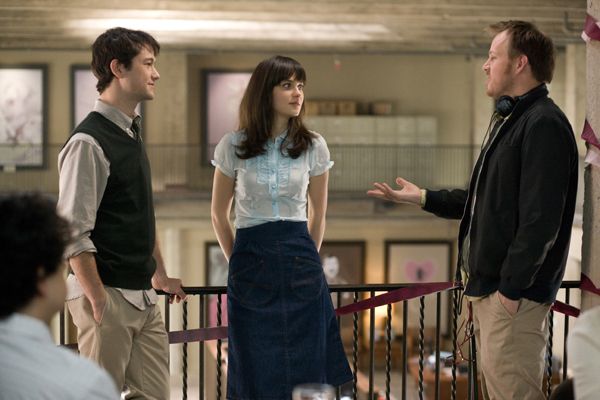
 The final product, after all the anticipation, certainly is epic, clocking in at 149 minutes, but whether or not it's a masterpiece isn't quite as certain. The film is about a group of Jewish-American soldiers who are dropped into occupied France in order to wreak havoc behind enemy lines before the rest of the Allied military makes its main assualt inland. Tarantino is a difficult director to evaluate objectively. His films are uniquely his own, despite the fact that he borrows so much from his various inspirations. This is the contradiction that is Quentin Tarantino. He is a well known lover of "genre cinema" which is a way of saying that he has spent a lot of time watching B-movies designed purposely to fit within the conventions of a specific genre, and these films directly influence his work. Some would say he outright steals from them.

 In the end, the audience has to make a simple choice. You can be continually disappointed that Tarantino will probably never make an entirely serious film without incorporating some element of parody or homage to genre cinema, or you can choose to accept him for who he is and appreciate his rare skill as a writer and his ability to show us a side of storytelling otherwise unavailable in the mainstream. It's up to you.
 Titanic, 12 years after its release, is still the most financially successful film ever made, and considering the inflation of ticket prices since '97 this is most impressive. To put it in perspective, the most successful film worldwide since Titanic is Lord of the Rings: The Return of the King (2003), and in order to match Titanic's $1.8 billion gross it would have needed to make an additional $700 million. That's the entire amount the hugely successful film Transformers made worldwide in 2007.

 The biggest piece of hype, however, is the film itself. Cameron is a master at making his films a can't miss event. Tomorrow, August 21, is officially "Avatar Day." The trailer released today on Apple.com will be released in theaters around the world, along with special limited screenings of a 15 minute preview, and the unveiling of the video game and toys to coincide with the film. If all goes according to plan, by the time December 18 rolls around just about everyone will feel compelled to see the film. Today the public got their first glimpse of the rumored mind-blowing effects, but you can bet that Cameron is keeping the most amazing footage under tight wraps so that the audience leaves the theater feeling like they've just witnessed something they've never seen before. The key to Titanic's success was word of mouth recommendations and repeat viewers after the first wave of people came away captivated. You can bet Cameron is banking on the same thing happening for Avatar.
 The setting of the story, South Africa, is significant in that the story seems to be an allegory of Apartheid. The aliens are given shacks for shelter and the means to survive, but they are segregated, discriminated against and exploited out of fear. But after all, they are, well... alien, and naturally don't interact well with humans. What they perceive as playful fun humans see as disruptive violence, and instead of making an effort to integrate them into society they are locked away and despised by the human majority. Under the guise of trying to help the creatures, an agency called MNU, sort for Multi-National United (whose trucks look more than a little bit like UN vehicles), are secretly trying to discover how to use alien weapon technology for their own gain, and all other ethical considerations are of no importance.
